
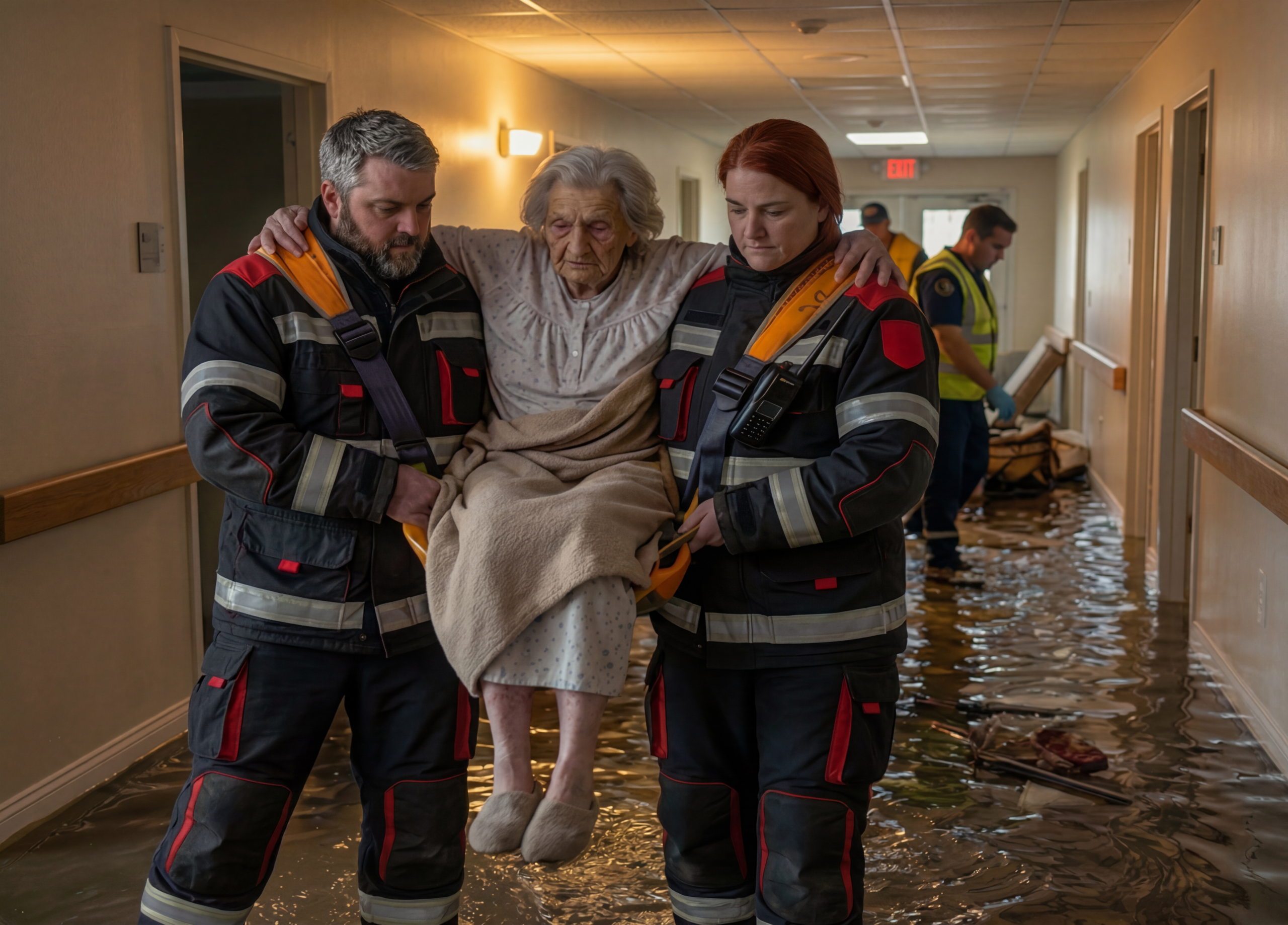
Two People. One Patient. Whatever You Have On You.
September 25, 2026 5:59 amPicture the scenario.
You’re on scene. The patient has a lower-limb injury (a fracture, a crush, an ankle that won’t take weight). They can’t walk out. The nearest litter team is committed to another patient. Your partner is right beside you. Between you, you have whatever you carried in.
What do you reach for?
That question doesn’t change based on what caused the disaster. It shows up the same way in flood evacuations, wildfire rescues, tornado aftermath, and hurricane extractions. The terrain changes. The weather changes. The specific challenge changes. But the core problem (two responders, one patient who can’t walk, limited equipment) stays constant across every major disaster type EMS teams face.
Fleetseat was designed as the answer to that specific problem.
Why Standard Equipment Struggles in Disaster Environments
The equipment in most EMS kits was designed for relatively stable environments: flat ground, accessible vehicles, adequate staffing. Disasters systematically remove all three.
Wheeled gurneys sink in mud, can’t navigate rubble, and require firm ground that flood and tornado response rarely provides. Rigid litters require four to six carriers, personnel that may simply not be available when a single incident generates dozens of simultaneous patient needs. Collapsible litters are better, but are still recommended to be operated with three or more people on uneven terrain, and they don’t fit in a kit bag or clip to a harness.
The gap they all share: they’re not with the responder when the responder reaches the patient.
In a flood, your vehicle may be two blocks back and the water is rising. In a wildfire, the wind shifted and the egress route just changed. In a tornado aftermath, the street you drove in on is blocked by a downed power line. In every case, the equipment that helps is the equipment already on your person.
What Fleetseat Actually Solves
Fleetseat weighs under 800 grams and clips to a harness or fits in any kit bag. That’s the most important thing about it in a disaster environment: it’s with you when you reach the patient, not stored somewhere that conditions may have made inaccessible.
It deploys in 15–20 seconds. Instructions are printed in high-visibility text directly on the device, readable in low light, with gloved hands, under stress. No assembly. No tools. No third person required.
The carrier handle design keeps one hand free per responder: for a radio, a rope, a door, or footing on unstable ground. The weight distribution system, developed with biomechanical experts, significantly extends carry range for most two-person teams compared to an unassisted carry, reducing fatigue and the frequency of crew rotation in situations where rotation may not be possible.
The Same Answer Across Four Disaster Types
Floods. The window before terrain becomes impassable is short. Two responders with a Fleetseat can move a patient from a flooded location to a staging area without waiting for a litter team, one hand free for a rope or paddle, no rigid frame to catch on debris or submerged obstacles.
Wildfires. Nursing home and care facility evacuations require repeated carries by the same personnel under physically demanding conditions. A carry system that reduces fatigue per carry means the same two-person team can move more patients before the window closes, without pulling additional staff from other simultaneous carries.
Hurricanes. Pre-landfall evacuation of mobility-impaired residents is time-critical. Two responders can move a non-ambulatory patient from home to vehicle quickly and repeatedly, without waiting for equipment that takes longer to deploy than the available window. Post-storm, the same capability applies in debris-strewn environments where wheeled equipment can’t operate.
Tornadoes. In the immediate aftermath, access is often limited to two-person crews working independently across a wide area. Fleetseat turns any two trained responders into a functional carry team, moving a patient from a triage point to an ambulance staging area without committing a four-to-six-person litter crew.
How It Fits Existing Protocols
Fleetseat complements standard equipment. It doesn’t replace it. Three consistent use cases across all disaster types:
- Initial extraction from a danger zone or compromised location to a safe staging area
- Secondary transport from triage to ambulance or airlift when primary equipment is committed elsewhere
- Shelter-in-place failures where patients must be relocated within a building or facility to a safer area
Get the patient out of immediate danger. Your standard equipment takes it from there.
The Numbers
| Fleetseat | Collapsible Litter | |
|---|---|---|
| Weight | Under 800g | 7–10 kg |
| Carriers required | 2 | 3–6 |
| Deployment time | 15–20 seconds | 2–5 minutes |
| Fits in a kit bag / on-person | Yes | No |
| Works across disaster terrain types | Yes | Limited |
In a mass casualty incident, those differences compound. Ten Fleetseats move ten patients simultaneously with twenty personnel, the same headcount traditional methods might use for three or four.
Who Should Have One
- Municipal EMS fleets in flood, wildfire, hurricane, and tornado-prone regions
- Rural volunteer fire and rescue squads
- Hospital and long-term care facility disaster caches
- State emergency management strike teams
- Faith-based and NGO rapid-response units
The Bottom Line
Floods, wildfires, hurricanes, tornadoes all ask the same thing of EMS: move the vulnerable, fast, with what you have on you. The disaster type changes. The core problem doesn’t.
At under 800 grams, Fleetseat is the lightest, fastest way to turn two responders into a functional carry team, across any terrain, in any disaster, without waiting for equipment that may not be reachable when you need it.
See where Fleetseat fits your team. Get in touch at info@thefleetseat.com or thefleetseat.com.
Categorised in: Uncategorised
This post was written by Luke