
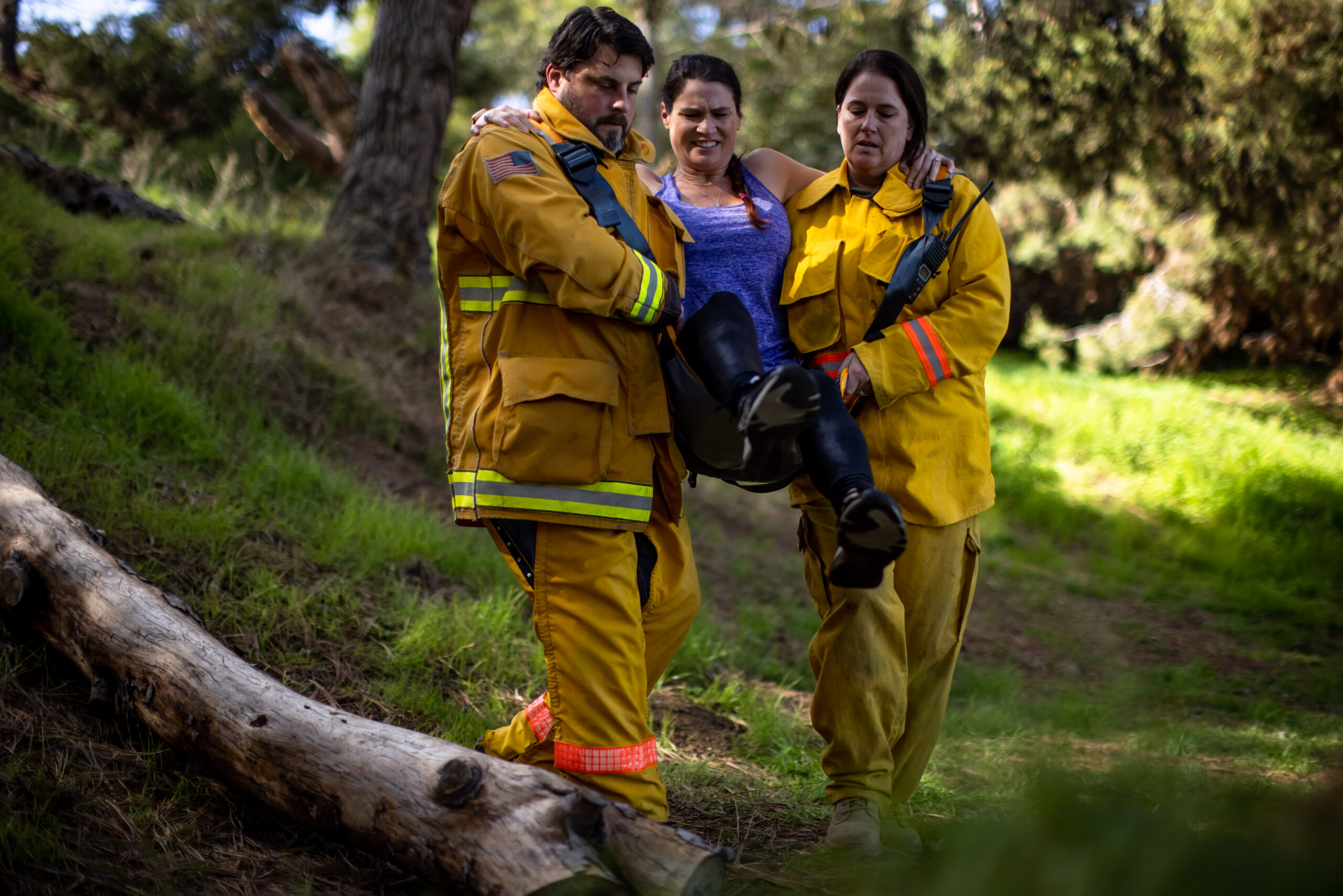
Four Miles In, No Cell Service, and Someone Can’t Walk Out
September 25, 2026 5:08 amIt’s one of the most common scenarios in wilderness search and rescue. A group is several miles from the trailhead. One person rolls an ankle, takes a bad step on loose rock, or sustains a knee injury on the descent. They can’t bear weight. Cell service is nonexistent. And the two friends beside them are about to discover that none of their options are good.
The fireman’s carry exhausts one person in minutes and jars the injury with every step. A trekking-pole litter is unstable, snags on vegetation, and realistically needs four to six people to carry safely. Waiting for SAR ties up a volunteer crew for hours (a single lower-limb injury on a busy weekend can occupy an entire team for six to ten hours), and in remote terrain, a helicopter extraction can cost upwards of $30,000.
Studies consistently show that 36–50% of all trail injuries involve the lower limbs. It’s the most common reason people activate emergency beacons or call 911 from the backcountry. And yet for most hiking groups, the gap between “someone can’t walk” and “SAR arrives” is filled with improvised solutions that risk worsening the injury and exhausting the people doing the carrying.
Fleetseat was designed specifically for that gap.
What It Is and How It Works on a Trail
Fleetseat is a two-person seated carry system weighing under 800 grams, roughly the weight of a water bottle, that fits in a pack’s side pocket or clips to a hip belt. It deploys in 15–20 seconds, with instructions printed in high-visibility text directly on the device. Two people who’ve never used it before can have a patient seated and moving within a minute of opening it, following the printed steps.
The seated carry position is well suited to trail evacuation. It keeps the patient’s centre of gravity low and stable, allows two carriers to navigate narrow tracks, uneven ground, and gentle obstacles without the rigid frame of a stretcher catching on vegetation or terrain. One hand remains free per carrier, useful for balance on technical sections, or for managing trekking poles.
For lower-limb injuries specifically (the injury type Fleetseat is designed for), the seated position keeps the patient stable and supported, reducing the risk of further injury from an improvised or uncontrolled carry.
Why It Matters to Two Very Different Groups
Recreational hikers. Two hiking companions can pick up Fleetseat’s printed instructions on the trail and move an injured person a mile or two to a forest road, a wider clearing, or a helicopter-friendly meadow, often all that’s needed to bring a multi-hour SAR operation down to a straightforward ambulance pickup. Less time exposed on the trail. Less pain for the patient. Less risk of the situation deteriorating while you wait.
SAR and EMS professionals. Every metre a hiking party moves a patient toward the trailhead is a metre your litter team doesn’t have to cover. In terrain where a wheeled litter can’t operate and a technical carry team would take hours to deploy, a hiking group that can self-evacuate a meaningful distance dramatically changes the resource equation. Reduced helicopter hover time, faster crew turnover on busy weekends, and a patient who arrives at the handoff point already stabilised rather than still at the point of injury.
Who Should Carry One
- Day hikers on longer or more remote routes
- Thru-hikers and multi-day trekking groups
- Families with children in backcountry environments
- Trail runners in remote areas
- Park rangers and outdoor guides
- Scout troops and youth groups
- Volunteer SAR teams as a lightweight cache item for handoff to hiking parties
A Note on Conditions and Limitations
Fleetseat is designed for flat, stable ground and is most effective in conditions where two carriers can walk safely side by side. On narrow single-track, technical terrain, or steep descents, carry speed will naturally slow, and in those conditions, experienced teams should assess carefully before proceeding. It’s not a replacement for a technical litter rescue in serious terrain. It’s the right tool for the common scenario where two people need to move a lower-limb-injured patient a short but critical distance to reach a point where more resources can take over.
Used in the right conditions, it consistently outperforms any improvised carry method, and it weighs less than most people’s lunch.
The Bottom Line
For hikers: Fleetseat closes the gap between “someone can’t walk” and “SAR arrives,” often turning a multi-hour operation into a self-managed evacuation to the trailhead.
For SAR and EMS professionals: it delivers a stabilised patient closer to where your resources are, saving time, reducing volunteer exposure, and freeing your crew for cases that genuinely need a full technical response.
At under 800 grams, the question before your next remote day out is simple: if someone in your group can’t walk two miles out, are you ready?
See where Fleetseat fits your next trip. Get in touch at info@thefleetseat.com or thefleetseat.com.
Fleetseat is TGA-approved. Under 800g. Deploys in under 20 seconds. Two carriers only.
Categorised in: Outdoor & Remote Access
This post was written by Luke